

What Is Comparable Of Cle De Peau Radiant Multi Repair Oil
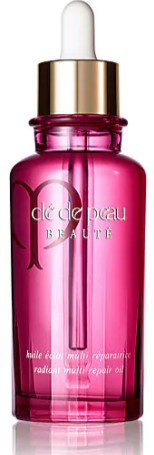
Radiant Multi Repair Oil
An exquisite multi-purpose face oil that leaves skin enchantingly dewy, visibly plump and firm, while reducing dullness and the appearance of wrinkles for boggling youthful resilience. Uniquely lightweight, not-viscid texture absorbs easily for a pleasurable shine feel on pare. Precious botanicals, Peony and Rare Orchid deliver a divine fragrance that delights the senses. For confront, body and pilus.
Uploaded past: whishaw on
Ingredients overview
H2o(Aqua/Eau), Glycerin, Methyl Gluceth-10, Dipropylene Glycol, Butylene Glycol, PEG-8, PEG/PPG-fourteen/vii Dimethyl Ether, PPG-13-Decyltetradeceth-24, Trehalose, Phenoxyethanol, PEG-20, Fragrance (Parfum), Phytosteryl/Octyldodecyl Lauroyl Glutamate, Tocopheryl Acetate, Sodium Citrate, Dipotassium Glycyrrhizate, Polyquaternium-51, Citric Acid, Butylphenyl Methylpropional, Limonene, Disodium EDTA, Ascorbyl Tetraisopalmitate, Sodium Acetylated Hyaluronate, Oryza Sativa (Rice) Germ Oil, Rosa Canina Fruit Oil, Camellia Japonica Seed Oil, Mortierella Oil(Huile De Mortierella), Hexyl Cinnamal, Citronellol, Linalool, Blastoff-Isomethyl Ionone, Benzyl Alcohol, PEG-thirty Soy Sterol, Hydrolyzed Silk, Hydrogenated Lecithin, Tocopherol, Bupleurum Falcatum Root Excerpt, Trisodium EDTA, Theanine, Hydrolyzed Conchiolin Protein, Ascorbyl Dipalmitate
Highlights
Key Ingredients
Other Ingredients
Moisturizer/humectant: Glycerin, Methyl Gluceth-10, Butylene Glycol, PEG-8, Trehalose, PEG-20, Dipotassium Glycyrrhizate, Polyquaternium-51, Sodium Acetylated Hyaluronate, Hydrolyzed Silk, Theanine
Skim through
| Ingredient name | what-it-does | irr., com. | ID-Rating |
|---|---|---|---|
| Water(Aqua/Eau) | solvent | ||
| Glycerin | skin-identical ingredient, moisturizer/humectant | 0, 0 | superstar |
| Methyl Gluceth-10 | moisturizer/humectant, emulsifying | ||
| Dipropylene Glycol | solvent | ||
| Butylene Glycol | moisturizer/humectant, solvent, viscosity controlling | 0, ane | |
| PEG-8 | moisturizer/humectant, solvent | ||
| PEG/PPG-14/7 Dimethyl Ether | |||
| PPG-13-Decyltetradeceth-24 | emulsifying, surfactant/cleansing | ||
| Trehalose | moisturizer/humectant | goodie | |
| Phenoxyethanol | preservative | ||
| PEG-20 | moisturizer/humectant, solvent | ||
| Fragrance (Parfum) | perfuming | disgusting | |
| Phytosteryl/Octyldodecyl Lauroyl Glutamate | emollient | goodie | |
| Tocopheryl Acetate | antioxidant | 0, 0 | |
| Sodium Citrate | chelating, buffering | ||
| Dipotassium Glycyrrhizate | soothing, moisturizer/humectant | goodie | |
| Polyquaternium-51 | moisturizer/humectant | ||
| Citric Acid | buffering | ||
| Butylphenyl Methylpropional | perfuming | icky | |
| Limonene | perfuming, solvent | disgusting | |
| Disodium EDTA | chelating | ||
| Ascorbyl Tetraisopalmitate | antioxidant, skin brightening | goodie | |
| Sodium Acetylated Hyaluronate | moisturizer/humectant | goodie | |
| Oryza Sativa (Rice) Germ Oil | emollient | ||
| Rosa Canina Fruit Oil | emollient | ||
| Camellia Japonica Seed Oil | emollient | ||
| Mortierella Oil(Huile De Mortierella) | |||
| Hexyl Cinnamal | perfuming | icky | |
| Citronellol | perfuming | icky | |
| Linalool | perfuming | icky | |
| Alpha-Isomethyl Ionone | perfuming | icky | |
| Benzyl Alcohol | preservative, perfuming, solvent, viscosity controlling | ||
| PEG-30 Soy Sterol | emulsifying, surfactant/cleansing | ||
| Hydrolyzed Silk | moisturizer/humectant | ||
| Hydrogenated Lecithin | emollient, emulsifying | goodie | |
| Tocopherol | antioxidant | 0-3, 0-3 | goodie |
| Bupleurum Falcatum Root Extract | |||
| Trisodium EDTA | chelating | ||
| Theanine | moisturizer/humectant, emollient | ||
| Hydrolyzed Conchiolin Poly peptide | |||
| Ascorbyl Dipalmitate | antioxidant |
Clé de Peau Beauté Radiant Multi Repair Oil
Ingredients explainedToo-called: Aqua | What-it-does: solvent
Practiced old h2o, aka H2o. The most common skincare ingredient of all. You tin can usually find information technology correct in the very first spot of the ingredient list, meaning it's the biggest affair out of all the stuff that makes up the production.
It's mainly a solvent for ingredients that practise not similar to dissolve in oils but rather in water.
Once inside the skin, it hydrates, but not from the exterior - putting pure water on the peel (hello long baths!) is drying.
I more than affair: the water used in cosmetics is purified and deionized (it means that almost all of the mineral ions within it is removed). Like this, the products can stay more than stable over fourth dimension.
- A natural moisturizer that's as well in our skin
- A super common, prophylactic, effective and cheap molecule used for more than than fifty years
- Not but a uncomplicated moisturizer just knows much more than: keeps the peel lipids between our peel cells in a healthy (liquid crystal) state, protects confronting irritation, helps to restore barrier
- Effective from as low as 3% with even more benefits at higher concentrations up to 20-forty% (effectually 10% is a proficient usability-effectiveness sweet spot)
- High-glycerin moisturizers are awesome for treating severely dry out skin
Read all the geeky details virtually Glycerin hither >>
A pale yellow, corn-derived liquid that works as a humectant ingredient helping the skin to cling onto h2o. It has a polish, silky feel and can reduce the tackiness of other humectants.
A articulate, colorless liquid that works as a solvent and viscosity decreasing ingredient. It also has keen skin-moisturizing abilities.
Butylene glycol, or allow's only call it BG, is a multi-tasking colorless, syrupy liquid. Information technology's a great pick for creating a nice feeling product.
BG'due south main job is usually to be a solvent for the other ingredients. Other tasks include helping the product to blot faster and deeper into the skin (penetration enhancer), making the production spread nicely over the peel (slip agent), and attracting water (humectant) into the skin.
Information technology's an ingredient whose rubber hasn't been questioned so far past anyone (at least not that nosotros know about). BG is canonical past Ecocert and is also used enthusiastically in natural products. BTW, it's also a food condiment.
A smallish polymer molecule (created from repeated units of Polyethylene glycol, aka PEG) that's used equally asolubilizer and viscosity command amanuensis.
Information technology is a clear, colorless liquid that is h2o-soluble and water-binding (aka humectant) and tin can help to solubilize sparingly-h2o soluble things (east.grand. vanilla, perfumes) into h2o-based formulas. Thanks to its water-binding power, it also prevents the drying out of formulas, peculiarly when combined with the swain hygroscopic agent, sorbitol.
 Nosotros don't have description for this ingredient yet.
Nosotros don't have description for this ingredient yet.
A type of sugar that hash2o-binding backdrop and helps to keep your skinhydrated.
It's pretty much the electric current IT-preservative. Information technology'due south safe and gentle, only fifty-fifty more than chiefly, information technology's not a feared-past-everyone-by and large-without-scientific-reason paraben.
Information technology's not something new: it was introduced around 1950 and today it tin can be used upwards to 1% worldwide. It can exist institute in nature - in green tea - but the version used in cosmetics is synthetic.
Other than having a good prophylactic contour and existence quite gentle to the skin it has some other advantages too. It tin be used in many types of formulations as information technology has smashing thermal stability (can be heated up to 85°C) and works on a wide range of pH levels (ph 3-10).
Information technology'southward often used together with ethylhexylglycerin as it nicely improves the preservative activity of phenoxyethanol.
We don't take clarification for this ingredient yet.
Also-called: Fragrance, Parfum;Parfum/Fragrance | What-it-does: perfuming
Exactly what information technology sounds: nice smelling stuff put into cosmetic products so that the stop product also smells squeamish. Fragrance in the US and parfum in the EU is a generic term on the ingredient listing that is fabricated up of xxx to 50 chemicals on average (merely it can accept as much every bit 200 components!).
If you are someone who likes to know what you put on your face then fragrance is not your best friend - there's no fashion to know what'south really in it.
Also, if your skin is sensitive, fragrance is again non your best friend. It'due south the number ane cause of contact allergy to cosmetics. Information technology's definitely a smart matter to avoid with sensitive peel (and fragrance of any blazon - natural is just every bit allergic equally synthetic, if non worse!).
An amino-acid (glutamic acrid) derived molecule that is claimed to form lamellar liquid crystals similar to the ones formed in the skin between skin cells (chosen lipid bilayer). The lipid bilayer is like the "mortar" between our peel cells ("the bricks") and is super of import for a salubrious pare barrier and keeping h2o in the upper layers of the skin.
And so Phytosteryl/Octyldodecyl Lauroyl Glutamate is apeel-lipid-like cloth that makes your skin nice and smooth (emollient) and keeps your skin hydrated. According to the manufacturer's tests, it is more effective than petrolatum in promoting the recovery of damaged skin and improving rough pare weather.
Also-called: Vitamin E Acetate | What-it-does: antioxidant | Irritancy: 0
It's the almost usually used version of pure vitamin E in cosmetics. Y'all can read all about the pure class here. This one is the and so-called esterified version.
According to famous dermatologist, Leslie Baumann while tocopheryl acetate is more than stable and has a longer shelf life, information technology'southward as well more poorly captivated by the skin and may not take the same crawly photoprotective effects as pure Vit Due east.
A little helper ingredient that is used to adjust the pH of the product. It also helps to go on products stay overnice longer by neutralizing the metal ions in the formula (they usually come from water).
The salt form of 1 of the main anti-inflammatory ingredients in the licorice found, monoammonium glycyrrhizinate. It's a yellowish powder with a squeamish sweet aroma.
Information technology'southward used mainly for its soothing and anti-inflammatory properties, just according to manufacturer info, it's also sebum regulating so it's a perfect ingredient for problem peel products.
A biocompatible copolymer (a big molecule that consists of more than one blazon of edifice blocks) that has the same construction as important cell membrane ingredient, phospholipid. It's a good skin moisturizer, leaves a silky, smooth experience on the skin and can assist to reduce irritation caused by some not-and then-squeamish ingredients (like surfactants).
Citric acrid comes from citrus fruits and is an AHA. If these magic iii letters don't tell you anything, click here and read our detailed description on glycolic acid, the near famous AHA.
So citric acid is an exfoliant, that can - only like other AHAs - gently lift off the dead peel cells of your skin and get in more smooth and fresh.
There is too some research showing that citric acrid with regular utilize (recall iii months and xx% concentration) can help sun-damaged skin, increase skin thickness and some nice hydrating things called glycosaminoglycans in the peel.
But according to a comparative report done in 1995, citric acid has less pare improving magic backdrop than glycolic or lactic acid. Probably that'southward why citric acid is ordinarily not used as an exfoliant but more equally a helper ingredient in small amounts to adjust the pH of a conception.
Also-chosen: Lilial | What-it-does: perfuming
A common fragrance ingredient that has a nice floral odor and too goes by the name Lilial. It is a known fragrance allergen and every bit of 1st of March 2022, it has been banned in the Eu due to animal studies showing a possible link to infertility (in rats - so no demand to panic fifty-fifty if you used a production earlier with Butylphenyl Methylpropional).
A supercommon and cheap fragrance ingredient. Information technology'due south in many plants, e.one thousand. rosemary, eucalyptus, lavender, lemongrass, peppermint and information technology'south the main component (about 50-90%) of the pare oil of citrus fruits.
It does smell nice simply the trouble is that it oxidizes on air exposure and the resulting stuff is not good for the skin. Oxidized limonene tin crusade allergic contact dermatitis and counts equally a frequent skin sensitizer.
Limonene'southward nr1 office is definitely being a fragrance component, only at that place are several studies showing that it'southward as well a penetration enhancer, mainly for oil-loving components.
All in all, limonene has some pros and cons, but - especially if your skin is sensitive - the cons probably outweigh the pros.
Super common little helper ingredient thathelps products to remain squeamish and stable for a longer fourth dimension. It does and so by neutralizing the metal ions in the formula (that usually get into there from water) that would otherwise crusade some non so nice changes.
It is typically used in tiny amounts, around 0.i% or less.
Also-called: Class of Vitamin C, Ascorbyl Isotetrapalmitate, Ascorbyl Tetraisopalmitate, ATIP;Tetrahexyldecyl Ascorbate | What-information technology-does: antioxidant, skin brightening
Tetrahexyldecyl Ascorbate is a stable, oil-soluble form of skincare big shot Vitamin C. If you practise non know, why Vitamin C is such a large deal in skincare, click hither and read all near it. We are massive vitamin C fans and have written about it in excruciating detail.
So now, you know that Vitamin C is great and all, but it's really unstable and gives cosmetics companies many headaches. To solve this problem they came up with vitamin C derivatives, and one of them is Tetrahexyldecyl Ascorbate (allow's call information technology ATIP in short).
It'south a really promising candidate (meet below), but while reading all the goodness about it in a minute, do not forget that derivatives non only have to exist absorbed into the skin merely likewise have to be converted to pure vitamin C (ascorbic acid or AA) and the efficacy of the conversion is ofttimes unknown. In addition, vitamin C's 3 magic backdrop (antioxidant, collagen booster, pare brightener) are all properly proven in-vivo (on real people), but for the derivatives, it's mostly in-vitro studies or in the case of ATIP, it'southward in-vitro and done by an ingredient supplier.
With this context in mind let's see what ATIP might exist able to do. First, it is stable (if pH < 5), piece of cake to formulate and a joy to work with for a corrective chemist.
Second, considering it's oil-soluble, its peel penetration abilities seem to be corking. So great in fact, that it surpasses the penetration of pure vitamin C threefold at the aforementioned concentration and information technology penetrates successfully into the deeper layers of the peel (that is ordinarily of import to do some anti-aging work). There is also in-vitro information showing that it converts to AA in the pare.
3rd, ATIP seems to have all 3 magic abilities of pure vitamin C: it gives antioxidant protection from both UVB and UVA rays, it increases collagen synthesis (even more than AA) and it has apeel brightening effect by reducing melanogenesis by more than eighty% in human melanoma cell cultures.
So this all sounds really keen, but these are only in-vitro results at this point. We could find Tetrahexyldecyl Ascorbate mentioned only in one published in-vivo study that examined the anti-aging properties of a silicone formula containing 10% AA and seven% ATIP. The authors theorized that the 10% AA is released slowly from the silicon delivery system and probably stays in the upper layer of the skin to give antioxidant benefits, while ATIP penetrates more rapidly and deeply and gives some wrinkle-reducing benefits. The study was a modest (10 patients), double-blind experiment, and the formula did prove some measurable anti-crumbling results. Even so, it is hard to know how much pure vitamin C or ATIP tin can be thanked.
Lesser line: a really promising, but non well-proven vitamin C derivative that can exist worth a try especially if yous similar experimenting (but if you like the tried and truthful, pure vitamin C will be your all-time bet).
Sodium Acetylated Hyaluronate is a variation of current IT moisturizer, Hyaluronic acid, where some h2o-loving -OH groups are replaced past amphipathic (partly water-loving and partly water-hating) acetyl groups. The modified molecule is claimed to have fifty-fifty better wet retention power than normal HA and meliorate affinity to the pare surface.
The better affinity comes from the acetyl groups that act as tiny "anchors" to attach the HA molecule to the skin. Staying on meridian of the skin meliorate and longer means longer-lasting surface hydration and improved elasticity. It is also less viscid and more cosmetically elegant than normal HA, and so no wonder the nickname of this molecule is super hyaluronic acrid.
Likewise-called: Rice Germ Oil | What-it-does: emollient
We don't have description for this ingredient nevertheless.
Also-called: Rosehip Oil | What-it-does: emollient
Though it says fruit oil in its name, the rosehip fruit contains the seeds that contain the oil. So this one is the aforementioned as Rosa Canina Seed Oil, or Rosehip Oil, known for its high omega fatty acid content (linoleic acid - 51%, linolenic acid - 19% and oleic acid - twenty%) and skin-regenerative backdrop.
There is a mutual misconception that rosehip oil contains vitamin C as the fruit itself does, but vitamin C is a water-soluble vitamin hence information technology is not independent in the oil. The antioxidant and regenerative properties of the oil probably come up from the oil-soluble tocopherols (vitamin E) and carotenoids (pro-vitamin A). Read more here.
Also-called: Camellia Oil | What-it-does: emollient
Nosotros don't take description for this ingredient yet.
We don't have description for this ingredient yet.
A mutual fragrance ingredient that smells like jasmine. Information technology is one of the "EU 26 fragrances" that has to be labelled separately because of allergen potential. Best to avoid if your skin is sensitive.
Citronellol is a very common fragrance ingredient with a prissy rose-like odor. In the UK, it'south actually the third most often listed perfume on the ingredient lists.
It tin be naturally found in geranium oil (nigh 30%) or rose oil (about 25%).
As with all fragrance ingredients, citronellol tin can also cause allergic contact dermatitis and should be avoided if you have perfume allergy. In a 2001 worldwide study with 178 people with known sensitization to fragrances citronellol tested positive in 5.6% of the cases.
In that location is no known anti-aging or positive peel benefits of the ingredient. It'due south in our products to brand it smell nice.
Linalool is a super common fragrance ingredient. Information technology'southward kind of everywhere - both in plants and in cosmetic products. It's role of 200 natural oils including lavender, ylang-ylang, bergamot, jasmine, geranium and information technology can be institute in 90-95% of prestige perfumes on the market place.
The trouble with linalool is, that simply like limonene information technology oxidises on air exposure and becomes allergenic. That's why a product containing linalool that has been opened for several months is more likely to be allergenic than a fresh one.
A study made in the UK with 483 people tested the allergic reaction to 3% oxidised linalool and two.3% had positive test results.
It'southward a common fragrance ingredient that is i of the "EU 26 fragrances" that has to exist labelled separately (and cannot be simply included in the term "fragrance/perfume" on the characterization) because of allergen potential. Best to avoid if your skin is sensitive.
Information technology's one of those things that help your cosmetics not to go wrong too presently, aka a preservative. It tin be naturally found in fruits and teas but can besides exist made synthetically.
No matter the origin, in pocket-size amounts (upwardly to i%) information technology's a nice, gentle preservative. Has to exist combined with some other nice preservatives, like potassium sorbate to be broad spectrum enough.
In loftier amounts, it can be a skin irritant, but don't worry, information technology'southward never used in loftier amounts.
We don't have description for this ingredient yet.
We don't take description for this ingredient all the same.
It's the chemically chopped upward version of normal lecithin. Most often it's used to create liposomes and to coat and stabilize other ingredients.
Also-chosen: Vitamin Due east | What-it-does: antioxidant | Irritancy: 0-three | Comedogenicity: 0-three
- Primary fat-soluble antioxidant in our skin
- Significant photoprotection against UVB rays
- Vit C + Vit East work in synergy and provide great photoprotection
- Has emollient properties
- Easy to formulate, stable and relatively inexpensive
Read all the geeky details almost Tocopherol here >>
Nosotros don't take description for this ingredient nonetheless.
A mutual helper ingredient that works as a and so-called chelating amanuensis. Ithelps products to remain nice and stable for a longer fourth dimensionby neutralizing the metallic ions in the formula (that usually go into at that place from water) that would otherwise cause some not so nice changes.
We don't have description for this ingredient still.
We don't have description for this ingredient even so.
We don't have description for this ingredient nonetheless.
You may likewise want to take a look at...
Normal (well kind of - it's purified and deionized) water. Usually the master solvent in cosmetic products. [more] A real oldie but a goodie. Great natural moisturizer and pare-identical ingredient that plays an important role in skin hydration and general peel health. [more] A pale yellow, corn-derived liquid that works equally a humectant ingredient helping the skin to cling onto water. [more than] A clear, colorless liquid that works as a solvent and viscosity decreasing ingredient. Information technology also has great skin-moisturizing abilities. [more] An often used glycol that works as a solvent, humectant, penetration enhancer and also gives a expert slip to the products. [more than] A smallish polymer molecule that is used as a solubilizer and viscosity control agent in cosmetic products. [more] A type of sugar that has water-binding properties and helps to keep your skin hydrated. Pretty much the current Information technology-preservative. It's safe and gentle, and tin be used up to 1% worldwide. [more] The generic term for nice smelling stuff put into cosmetic products and so that the end product too smells dainty. It is fabricated upwardly of 30 to 50 chemicals on average. [more than] An amino-acid (glutamic acid) derived molecule that is claimed to course lamellar liquid crystals similar to the ones formed in the pare between skin cells (chosen lipid bilayer). [more] A form of vitamin E that works as an antioxidant. Compared to the pure form it'due south more stable, has longer shelf life, but it'south also more poorly absorbed by the skin. [more] A helper ingredient that is used to adjust the pH of the product. Also helps to go along products stay overnice longer by neutralizing the metallic ions in the formula. The salt form of 1 of the main anti-inflammatory ingredients in the licorice plant, monoammonium glycyrrhizinate. It's a xanthous powder with a nice sugariness smell. It'south used mainly for its soothing and anti-inflammatory properties, but according to manufacturer info, information technology'southward likewise sebum regulating and so it' [more than] A biocompatible copolymer with a similar structure to cell membrane ingredient, phospholipid. It's a good skin moisturizer and tin can besides help to reduce irritation. [more than] An AHA that comes from citrus fruits. It is usually used as a helper ingredient to adjust the pH of the formula. [more] A common fragrance ingredient that has a dainty floral aroma and also goes by the name Lilial. It is a known fragrance allergen and as of 1st of March 2022, it has been banned in the Eu due to animal studies showing a possible link to infertility (in rats - so no need to panic even if y'all used a product earlier with Butylphenyl Methylpropional). [more] A super common fragrance ingredient establish naturally in many plants including citrus peel oils, rosemary or lavender. It autoxidizes on air exposure and counts as a common peel sensitizer. [more than] Super mutual little helper ingredient that helps products to remain nice and stable for a longer time. It does so by neutralizing the metal ions in the formula (that usually get into at that place from water) that would otherwise cause some not and then overnice changes. [more] A stable, oil-soluble form of Vitamin C, that might have (in-vitro results) all the magic abilities of pure vitamin C (antioxidant, collagen booster, skin brightener). [more] Sodium Acetylated Hyaluronate is a variation of current IT moisturizer, Hyaluronic acid, where some water-loving -OH groups are replaced by amphipathic (partly water-loving and partly water-antisocial) acetyl groups. [more] Though information technology says fruit oil in its name, the rosehip fruit contains the seeds that contain the oil. So this i is the same every bit Rosa Canina Seed Oil, or Rosehip Oil, known for its loftier omega fat acrid content (linoleic acid - 51%, linolenic acid - 19% and oleic acid - 20%) and pare-regenerative properties. [more] A mutual fragrance ingredient that smells similar jasmine. Information technology is i of the "EU 26 fragrances" that has to be labelled separately because of allergen potential. [more] A common fragrance ingredient with a prissy rose-like olfactory property. [more] A super mutual fragrance ingredient that tin be found amid others in lavender, ylang-ylang, bergamot or jasmine. The downside of it is that information technology oxidises on air exposure and might become allergenic. [more] It's a common fragrance ingredient that is one of the "European union 26 fragrances" that has to be labelled separately (and cannot be simply included in the term "fragrance/perfume" [more] It's one of those things that assist your cosmetics not to get wrong as well before long, aka a preservative. It can be naturally found in fruits and teas but can as well be made synthetically. No matter the origin, in small amounts (up to i%) it's a dainty, gentle preservative. [more] It's the chemically chopped up version of normal lecithin. About often it's used to create liposomes and to coat and stabilize some other ingredient. Pure Vitamin E. Swell antioxidant that gives significant photoprotection against UVB rays. Works in synergy with Vitamin C. [more] A common helper ingredient that works as a so-chosen chelating agent. It helps products to remain nice and stable for a longer time past neutralizing the metal ions in the formula (that usually get into there from water) that would otherwise cause some not so nice changes. [more]

Source: https://incidecoder.com/products/cle-de-peau-beaute-radiant-multi-repair-oil
Posted by: smiththerhatim.blogspot.com
0 Response to "What Is Comparable Of Cle De Peau Radiant Multi Repair Oil"
Post a Comment